Swimming Lessons for People with Special Needs in Velenje
INTRODUCTION
Swimming is an excellent activity for people with special needs. It strengthens their physical ability, with an impact on mental wellbeing, social inclusion, and health. Moving in water and swimming is an activity that can be done from the earliest stages of life into old age.
THE PHILOSOPHY OF THE HALLIWICK SWIMMING METHOD
This educational programme for disabled people was developed in 1949 by James McMillan in London, England. It is based on the principles of hydrodynamics and hydrostatics, and known as the Halliwick Method. An important characteristic of the Halliwick Method is its individual approach to teaching, whereby each teacher works with only one student, regardless of the size of the overall group. Aids to buoyancy, such as swimming rings or flotation boards, are not recommended or used during the teaching, and neither are swimming goggles. Learning takes place in a relaxed and friendly environment. The most important teaching method is teaching through games.
TEACHER TRAINING THROUGH THE HALLIWICK METHOD
Five years ago, there was a small number of trainers and assistants who had complete training in the Halliwick Method. It was brought to Slovenia by a neurotherapist, Neda Rotar, and a professor at the Pedagogical Faculty in Ljubljana, Dr Rajko Vute. They completed their entire training in London, and today they possess all the necessary qualifications to pass on the training to others. The first Halliwick Method teachers in Slovenia were from the ranks of neurotherapists, parents of children with special needs, and Faculty of Education students involved in sporting activity.
We began to break new ground three years ago, with the Faculty of Sport, Department of Swimming, and the Swimming Association of Slovenia, educating over 60 swimming instructors. They are recruited with brief presentations during licensed seminars, after which they are invited into training. Since the Halliwick method requires one instructor for each trainee, there is an obvious need for a large number of staff.
In the past year we have also managed to establish the seminar in the list of courses for continuous professional development of teachers. Involvement in the programme helps teachers with promotion, and it is well supported financially by the Ministry of Education and Sport. Participation has been very good.
We have also introduced the seminar into the mandatory list of secondary school courses. We are connected to schools and with mentors in surrounding areas who encourage voluntary work. Voluntary work can also be used by students towards fulfilment of the mandatory course content. This year the student volunteers received recognition from the Slovenian President, Mr Danilo Turk, for the project ‘Let’s Volunteer’ prepared by the Youth Council of Slovenia. This year we obtained funding from the Foundation for the Disabled and other contributors from all over Slovenia, and have already carried out educational programmes.
ORGANIZATION OF CENTRES AND SOCIETIES IN SLOVENIA
Swimming centres initially only existed as a part of various institutes that include children and adolescents with special needs (Črna, Kamnik, Vipava). Today there are also swimming centres in Ljubljana (Swimming Society Halliwick), Velenje (Velenje Swimming Club), Maribor, Krsko Celje, Kranj, and in the Soča Institute for Rehabilitation in Ljubljana. Some spas also offer their guests courses in the Halliwick Swimming Method. But we are not yet satisfied. We want children and young people to be able to take part in water activities and swimming during the day as well as in the evenings.
TEACHING SWIMMING TO PEOPLE WITH SPECIAL NEEDS
The first objective is the swimmer’s safety, and complete trust and confidence in the water. This is followed by learning the techniques of swimming. The time required to attain this first objective is completely irrelevant. Each individual must be allowed to develop his or her own adaptation to the dynamic forces of water, through the direction of the teacher, until it becomes automatic.
The swimming learning programme consists of 10 points (alignment, rotation, ease of motion), to be gradually mastered by the student before moving on to learn swimming techniques. Learning progress is evaluated by a system of swimming badge awards: red, yellow, green and blue. The badges increase student motivation, allow key learning points to be tracked, and enable progress to be systematically monitored. It is important to note that the individual badges are a part of the learning process and not an end in themselves.
People with special needs typically require an individual approach that is tailored to their developmental abilities. The work programme for children must support proper development of the child in all areas until the final stages of growth. Instructions are given clearly, simply and directly; exercises are demonstrated; and if necessary, swimmers are physically led to proper swimming positions. Progress is achieved through a system of 10 activities, and we show consistent, predictable and respectful care, and a friendly attitude. With the ability to adjust the teaching methods to an individual’s abilities, it is possible to successfully carry out teaching and award the participants with recreational sport activity, and participation in various competitive activities and even in swimming competitions.
PURPOSE AND OBJECTIVES
The purpose of the adjusted Halliwick Swimming Method is to include in
sport and recreational activity children and young people with special needs, and also to implement individualized swimming programmes and track individual progress. The objectives which we have set have been individualized at all the various stages: the adaptation of the method, the learning of basic swimming techniques, the deepening of social interactions between participants, and integration into the wider social environment (with friendships developing with other swimmers in the pool).
METHODS AND COURSE WORK
The work at Velenje’s indoor pool was based on the principle of one instructor to one or two participants. Work was carried out in a small pool with the depth between 0.8 and 1.2 metres. In that setting, students are able to gain independence of simple movements in the water, all the way through to acquiring basic swimming techniques.
These objectives are indirectly achieved through games – including elements of stories, animal themes, music games, counting games, and so on. Games are tailored to age. For children, the games are familiar and easy to remember; for young people they are competitive and exploratory; for adults they are puzzle-based. This year, students who have been practising for the past three years, along with those who are showing rapid progress, are learning basis swimming techniques (backstroke, free stroke, butterfly and breast stroke) in a large swimming pool (1.8 metres deep). Sport and recreational exercise take place twice a week for 60 minutes. Parents can register children at any time during the year, after completing the entry form.
DESCRIPTION OF GROUP SAMPLE
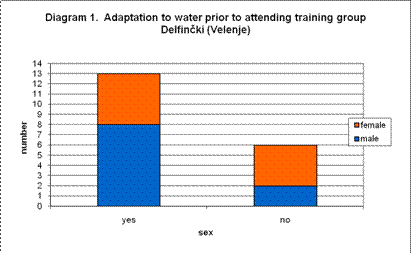
In early October 2008, 12 people entered the programme, with an average age of 16.75. During the year, 7 more children with an average age of 5.8 joined. Within the group, 13 members had already adapted to the water, and the remaining 6 were not. Diagram 1 shows the adaptation to the water, between males and females.
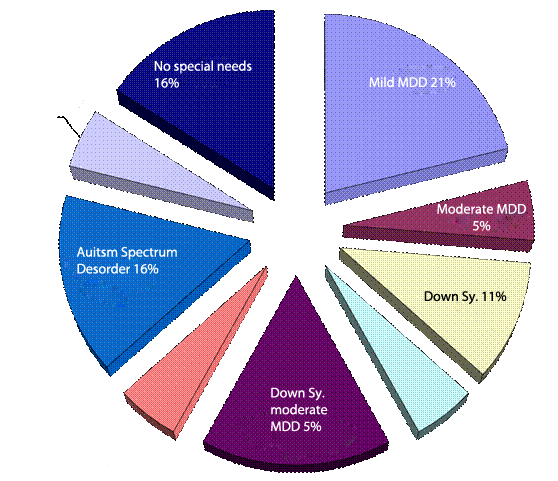
Students who were included in the swimming programme had different abilities and needs, while 3 children did not have special needs. Diagram 2 shows the distribution of special needs amongst students.
RESULTS
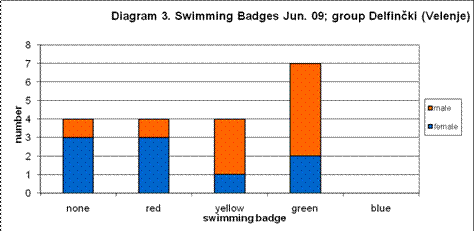
At the end of the programme in June 2009, we checked the progress of the swimmers and further motivated them by awarding badges. Diagram 3 shows the numbers who attained each level. Red badges were obtained by 2 girls who joined during the year. Practice sessions were also occasionally attended by a girl with a mild case of impaired social development, and she also managed to earn a red badge for gradually gaining independence in the water. 7 swimmers achieved the green badge, for mastering the basic style of swimming, and will now proceed to their second year. 2 swimmers progressed from a red badge to a green one. Disorders present within the group are Autism Spectrum Disorders (ASD), Down’s syndrome, and different stages of mental and social developmental disorders.
CONCLUSION
Collected results show that the set goals were achieved: the inclusion in sport of children and adolescents with special needs, inclusion in their surroundings, encouragement of cognitive development. It is important to spread the positive results of swimming and to popularize it among people with special needs in order to help them with developing an active lifestyle. In particular, it is important for people with social needs to socialize with others, in order that they can follow a normal process of development. Swimming opens up opportunities for learning social interactions and social inclusion in a way which school on its own cannot offer. We also emphasize the individualized approach to learning (mastering the new motor skills), through which each individual can achieve success and be included in the group.
The results show that anyone, regardless of physical or mental ability, can, if they regularly attend practice and if they use the appropriate methods of learning, master the skill of swimming. We have already participated in the first Halliwick water festival in Ljubljana, which was attended by swimmers from many centres in Slovenia, along with other people with similar interests. Early in the spring, we ran a weekend course for instructors at Rogla, further developing social contacts.